

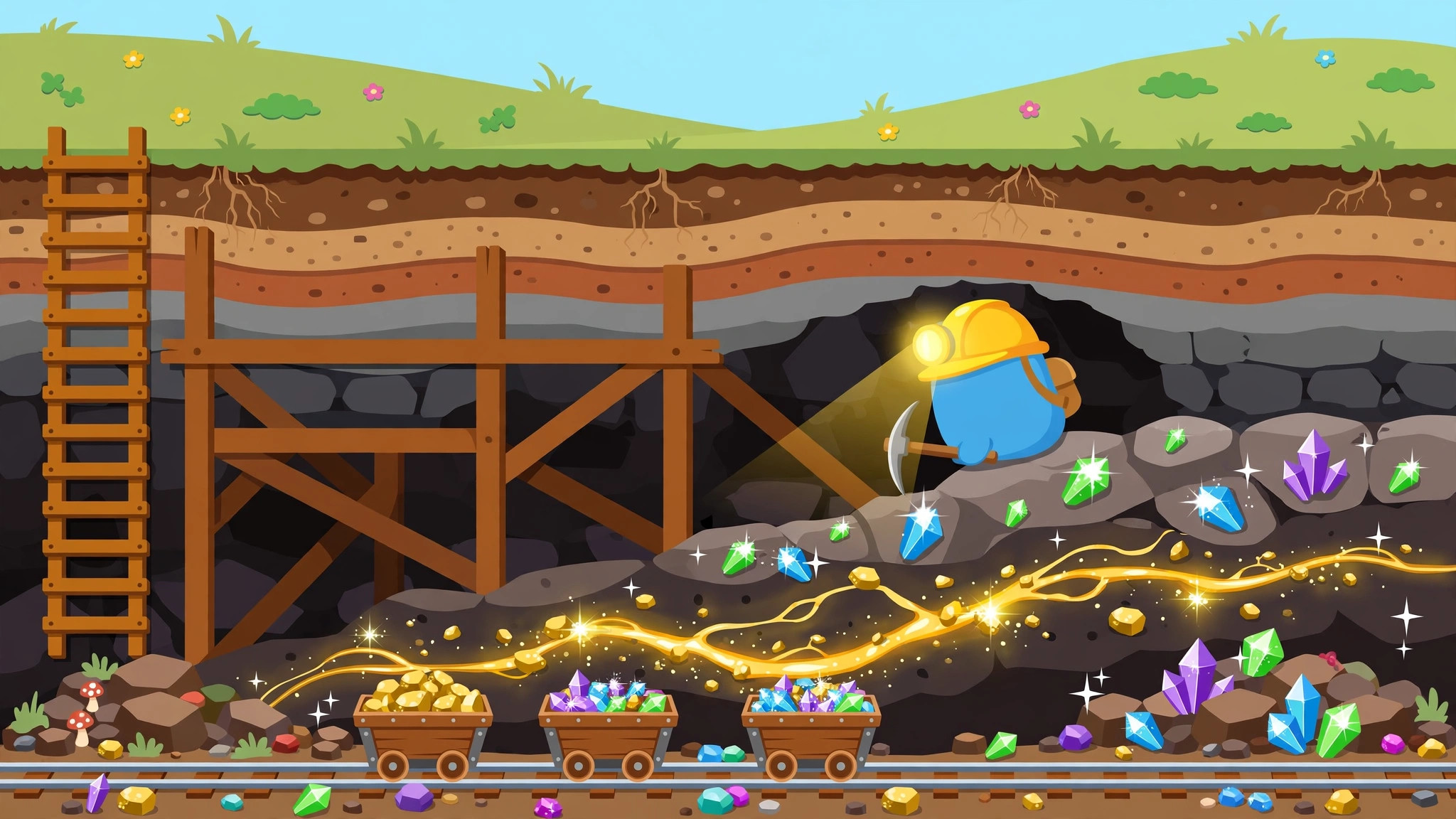
Every miner knows the rule: the good stuff is never on the surface. Gimkit Dig It Up builds a whole game mode around that idea. You start at ground level with a basic pickaxe and a head full of review questions, and you dig down: through dirt, through stone, into layers where the ores get rarer, tougher, and far more valuable the deeper you go.
Dig It Up is one of Gimkit’s 2D modes, but it has more in common with a resource-management game than a brawler. Nobody is chasing you. The race is against the clock and against your classmates’ depth charts, and your digging speed is powered entirely by how fast and accurately you answer questions. This guide explains the full mining loop, what waits underground, and the upgrade decisions that separate the deepest miners from everyone still scratching at the topsoil.
how to play dig it up
The surface is just the lobby. Underneath it, the world of Gimkit Dig It Up is a vertical mine: layers of blocks stacked downward, with better rewards buried deeper. You play as a Gim, move and jump like in other 2D modes, and answer questions correctly to earn the energy that keeps you digging.
The core loop looks like this:
- Answer questions to earn energy. Energy powers your digging. No answers means no progress, so your question pace sets your mining pace from the first block.
- Dig downward. Break blocks beneath you to descend. Soft surface blocks give quickly; deeper layers are harder and take better tools.
- Collect ores as you go. Different blocks contain different ores and resources. Common finds near the surface fund your start; the valuable material waits far below.
- Upgrade your tools. Spend what you earn on stronger pickaxes and better gear. Upgrades let you break harder blocks faster, which is the only way to keep descending efficiently.
- Keep pushing deeper. Each new layer raises the value of what you can mine. The game’s real contest is who converts questions into depth and valuable ore fastest.
- Finish with the most value. When the game ends, the miners who dug smart, upgraded early, and spent their time in the rich layers come out on top.
Two things surprise new players. First, digging straight down in one shaft is satisfying but not always smart: ores are found by exploring the layer you are in, not just passing through it. Second, your pickaxe matters more than your speed. A fast answerer with a weak pickaxe will watch a slower classmate with better tools cruise past them into the deep layers. Upgrades are not a luxury in this mode; they are the game.
If you enjoy building value from resources over time, the farming economy of Gimkit Farmchain will feel like a close cousin, and our survey of Gimkit 2D modes shows how Dig It Up fits alongside the platformers and PvP modes.
What you find underground
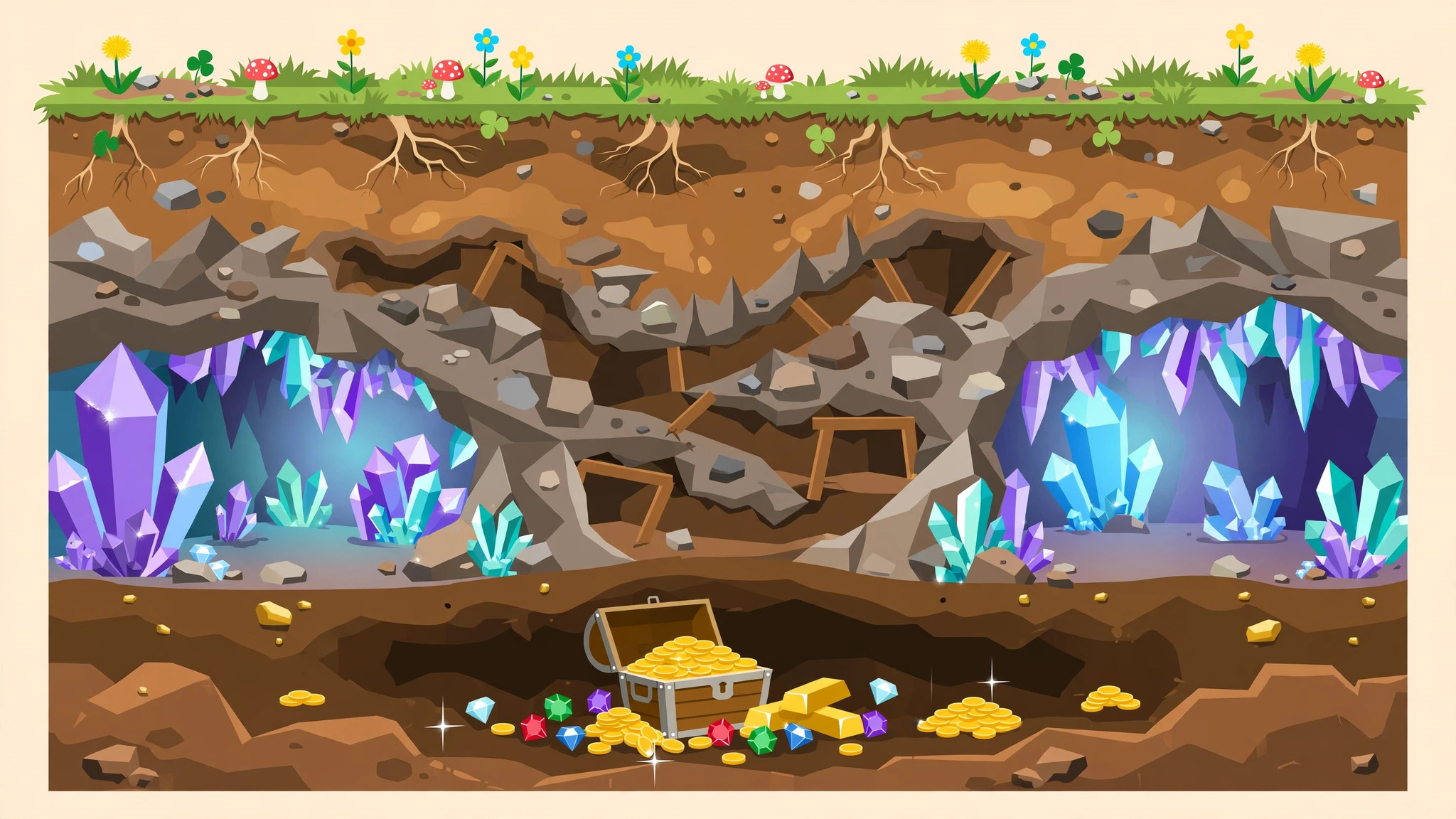
The underground is organized as a difficulty and value gradient. Near the surface, everything is soft and cheap: quick blocks, common ores, small payouts. This top layer is not the goal; it is the tutorial and the bank. Its job is to fund your first pickaxe upgrade without wasting much time.
As you descend, blocks harden and ores improve. Mid-depth layers are where the game actually happens for most of a class period: valuable enough to matter, soft enough that a mid-tier pickaxe keeps you moving. The smart play is usually to reach this band quickly and mine it thoroughly rather than heroically grinding one block at a time toward the bottom with inadequate tools.
The deepest layers hold the richest finds in the game, but they guard them with the hardest blocks. Reaching them with a weak pickaxe is possible in the same way walking to another city is possible: technically, and pointlessly. The miners who win are the ones who arrive at depth with the tool the layer demands, harvest efficiently, and still have time left to enjoy it.
A sample run, phase by phase
It helps to see how a strong Gimkit Dig It Up run is paced. The opening phase is all surface work: dig fast, collect the easy ores, and answer at maximum speed, because every second of early game is really about buying your first real pickaxe. Good miners treat the topsoil like a toll booth: pass through it, pay as little time as possible, and get the upgrade that makes the rest of the run cheaper.
The middle phase is about choosing a layer and committing to it. Once your pickaxe is respectable, drop to the mid-depth band and mine it properly, widening your workings and clearing pockets of ore instead of spearing downward. This is where most of the game’s reliable money is made, and where the scoreboard quietly separates organized miners from wanderers. If a classmate’s earnings suddenly jump, they have found this rhythm; match it rather than chasing them downward.
The endgame flips the priorities again. With a strong tool and limited time, depth finally becomes the right play: push for the rich layers, harvest what you can reach, and do not spend your last minutes traveling. A common losing pattern is arriving at the deepest ore with a great pickaxe and no time left to mine it. The winners are not always the deepest miners; they are the ones whose depth, tools, and time left all peak together at the final whistle.
Teachers can even narrate this arc to a class before the first run. Once students see the game as three pacing decisions (fund the tool, work the middle, spend the endgame at depth), their second runs improve dramatically, and the mode becomes a tidy lesson in planning under a deadline.
dig it up tips
- Upgrade earlier than feels comfortable. Every minute spent digging hard blocks with a weak pickaxe is wasted twice: once on the slow digging, and once on the upgrade you could have already bought. As soon as an upgrade is affordable and the blocks are slowing you down, buy it.
- Answer in a rhythm, not bursts. Steady energy income keeps your digging continuous. Burst answering followed by a long pause spends half the game standing still underground.
- Mine the layer, not just the shaft. When you reach a new band, spend a little time widening your hole. Ores cluster in layers, and a one-block shaft past a rich pocket is the classic beginner heartbreak.
- Budget time by depth. Early layers are cheap to cross. Save your late-game minutes for the rich layers, not for dithering near the surface.
- Watch what leaders do. If a classmate is suddenly pulling away, they have almost certainly upgraded before you. Mirror the investment rather than digging harder with worse tools.
- Do not ignore XP. Like other 2D modes, Dig It Up pays XP for correct answers and objectives, so even a mid-pack finish still moves you toward GimBucks and cosmetics. Our guide to Gimkit levels explains how that XP adds up.
Dig It Up in the classroom
Teachers tend to love Dig It Up for one reason: it is competitive without being confrontational. Students race the depth chart rather than each other, so nobody gets knocked out, hunted, or humiliated; the slowest miner in class is still happily digging their own hole at their own pace. For classes where direct PvP modes create friction, that is a genuinely valuable property.
The mode also teaches a clean economic lesson that students feel in their hands: invest early in better tools and the whole rest of the game gets easier. It is compound growth with a pickaxe. A two-minute debrief afterwards (“when did you upgrade, and what happened next?”) lands surprisingly well even with younger classes.
Practical hosting notes: give the mode a full, unhurried slot rather than a five-minute gap, because the payoff lives in the deeper layers that take time to reach. And remember that featured modes rotate on the free plan while Gimkit Pro unlocks everything; confirm Dig It Up is in your mode picker before the lesson, using the official Gimkit Help Center if anything looks different than expected.
Frequently asked questions
What is the goal in Dig It Up?
Dig down through the layers, collect increasingly valuable ores, upgrade your tools, and finish with the most value. Depth and upgrades are the whole game.
How do you dig faster in Dig It Up?
Two ways: answer questions faster to keep your energy flowing, and upgrade your pickaxe as soon as harder blocks start slowing you down. Tool quality matters as much as answering speed.
Are better ores always deeper?
Yes, that is the core design. Surface layers are soft and low-value; deeper layers are harder to dig but hold much richer ores.
Does Dig It Up give XP and GimBucks?
Yes. It is a 2D mode, and 2D modes award XP for correct answers and objectives, which converts into GimBucks to spend on Gims, trails, and stickers.
Is Dig It Up a PvP mode?
No. It is a race against your classmates’ results rather than a fight. Nobody can knock you out of your own mine, which makes it one of the calmer competitive modes.
How long should a game of Dig It Up last?
Long enough for the class to reach the interesting layers, which usually means a full activity slot rather than a five-minute filler. The first minutes are setup: surface digging and the first upgrade. The real game starts once students hit the mid-depth ores, and cutting a session off just as they get there wastes the mode’s best teaching moments. If time is tight, shorten something else.
The first stronger pickaxe, bought as early as you can afford it. It is tempting to keep digging and save for something bigger, but every block broken with the starter tool is slower than it needed to be. The earliest pickaxe upgrade pays for itself within a couple of layers and funds everything after it, which is why experienced miners treat it as the true start of the game.
