For once, the best answer is a picture. Gimkit Draw That is the platform’s drawing-and-guessing party mode: one player gets a prompt and has to draw it, everyone else has to figure out what on earth the drawing is supposed to be, and correct guesses are how you win. No question bank decides this game. A wobbly sketch of a toaster does.
Draw That matters because it breaks Gimkit’s usual hierarchy completely. The fastest quizzer in the class gets no advantage here; the student with the clear visual brain, the one who can reduce “birthday cake” to three lines and a candle, becomes the star. And the guessers’ side is pure vocabulary in disguise: you cannot guess a word you do not know, which makes the mode a sneaky language lesson wearing a party hat. This guide explains how a game flows, how to draw prompts people can actually guess, how to guess like a professional, and where Draw That fits in a real classroom.
how to play draw that gimkit
A game of Draw That runs on a simple rotation that the whole class understands within one round:
- One player becomes the artist. The game hands a prompt, a word or short phrase, to a single player. Everyone else becomes a guesser for this round.
- The artist draws the prompt. Using the drawing tools, the artist sketches the prompt as clearly as they can. The comedy begins immediately, because the gap between the prompt in your head and the drawing on the screen is where this game lives.
- Guessers type what they see. Everyone else races to name the drawing. Guessing is a vocabulary sprint: the obvious word, its synonyms, and its near neighbors all deserve a try, because the prompt might be any of them.
- Correct guesses score. Players who identify the drawing are rewarded, and the artist benefits when their drawing is understood, which aligns everyone’s incentives beautifully: artists try to be clear, not tricky, and guessers try to be fast, not funny.
- The pencil rotates. A new artist takes the next prompt, and the game continues until everyone has had their turn in the spotlight and the standings are final.
That incentive design is the quiet brilliance of the mode. In many classroom games, one student’s success is another’s failure. In Draw That, the artist and the successful guessers win the same moment together, so the room roots for the drawing to make sense. The loudest cheers in a Draw That game happen when a terrible drawing finally gets guessed, a victory absolutely nobody achieved alone.
Gimkit Draw That sits in the same lighter, social corner of the platform as Gimkit This or That, our guide to the voting game, and it pairs wonderfully with the cooperative energy of Gimkit Team Tycoon.
draw that mode gimkit
Two different skills win this game, and most players are only practicing one of them.
Drawing well (in the only sense that matters). Forget artistry; Draw That rewards translation. The winning techniques are almost insultingly practical:
- Draw the category first. A box with waves is nothing; a box with waves under a sun is a beach scene. Context props (a plate under the blob, a leash on the blob) tell guessers what universe they are guessing in.
- Exaggerate the signature feature. A giraffe is a long neck with spots; a bicycle is two circles and a frame. Find the one feature that cannot belong to anything else and draw it biggest.
- Add a second clue instead of fixing the first. If your elephant looks wrong, drawing a circus tent next to it rescues the round faster than erasing and redrawing the elephant.
- Draw big and simple. Fine detail is invisible at classroom speed. Thick, bold, unmistakable shapes are the entire art style of winning Draw That players.
Guessing well (the underrated half). Guessers score the points, and the good ones share habits too. Guess the category early (“animal!”), then narrow relentlessly with each new line the artist adds. Say your guesses even when unsure, because a wrong guess costs almost nothing and a hesitant right one costs the round. And read the artist: students draw what a thing looks like in their heads, so guess the common version of an object, not the exotic one.
The metagame. Experienced classes develop a house style: certain students always draw food with a plate, someone else draws every animal with the same body. Regular players learn each other’s visual habits the way poker players learn tells, and the guessing gets scarily fast. A teacher rotating new artists in keeps the game honest, and a class that plays regularly starts keeping informal statistics: whose drawings get guessed fastest, whose guesses are eerily accurate, which prompts nobody survives. None of it is recorded anywhere official, and all of it is remembered perfectly, which is exactly how playground legends have always worked.
Prompts that sing and prompts that sink
Every Draw That session teaches the same quiet curriculum about communication, and it is worth making explicit for students after a game or two, because the pattern transfers to everything from essay writing to explaining math homework.
Some prompts are gifts. Concrete objects with one unmistakable feature (lighthouse, pineapple, snowman) draw themselves; the artist’s only job is scale and confidence. Action prompts are the interesting middle: “fishing” and “birthday party” cannot be drawn as objects, so the artist has to stage a scene (rod, water, fish; cake, candles, balloons), and guessers have to read scenes instead of nouns. This is where the mode quietly becomes a lesson in how much of language is verbs wearing costumes.
And some prompts sink the round no matter who draws them: abstract ideas with no agreed visual shorthand (“homework,” “yesterday,” anything ending in “-ness”). Everyone who has played knows the sinking feeling of watching a brave classmate draw a rectangle and point at it desperately. Teachers learn to love these rounds anyway, because the rescue attempt (the artist adds a clock, a desk, a second rectangle, pure hope) is the funniest and most memorable moment of the game, and because the class’s post-round debate about how anyone could possibly draw “yesterday” is a genuine little seminar on symbols.
The transferable insight, worth saying out loud once: a drawing fails the same way an explanation fails, when the audience’s picture and yours quietly differ. Students who have lost a round to that gap start checking comprehension in group work without being asked. They ask “wait, do you mean the big one?” in October because a September drawing of a lighthouse was guessed as a rocket. No worksheet accomplishes that, and certainly none accomplishes it while the class is roaring with laughter.
Draw That in the classroom
Gimkit Draw That’s classroom value hides inside its silliness. For language learners, it is close to perfect: the guesser must produce the English word, exactly spelled well enough to count, under joyful pressure, and the artist must understand the prompt deeply enough to translate it into an image. Teachers of younger students get labelling and vocabulary retrieval; teachers of older students get a brain-break that still runs on curriculum words if the prompts cooperate.
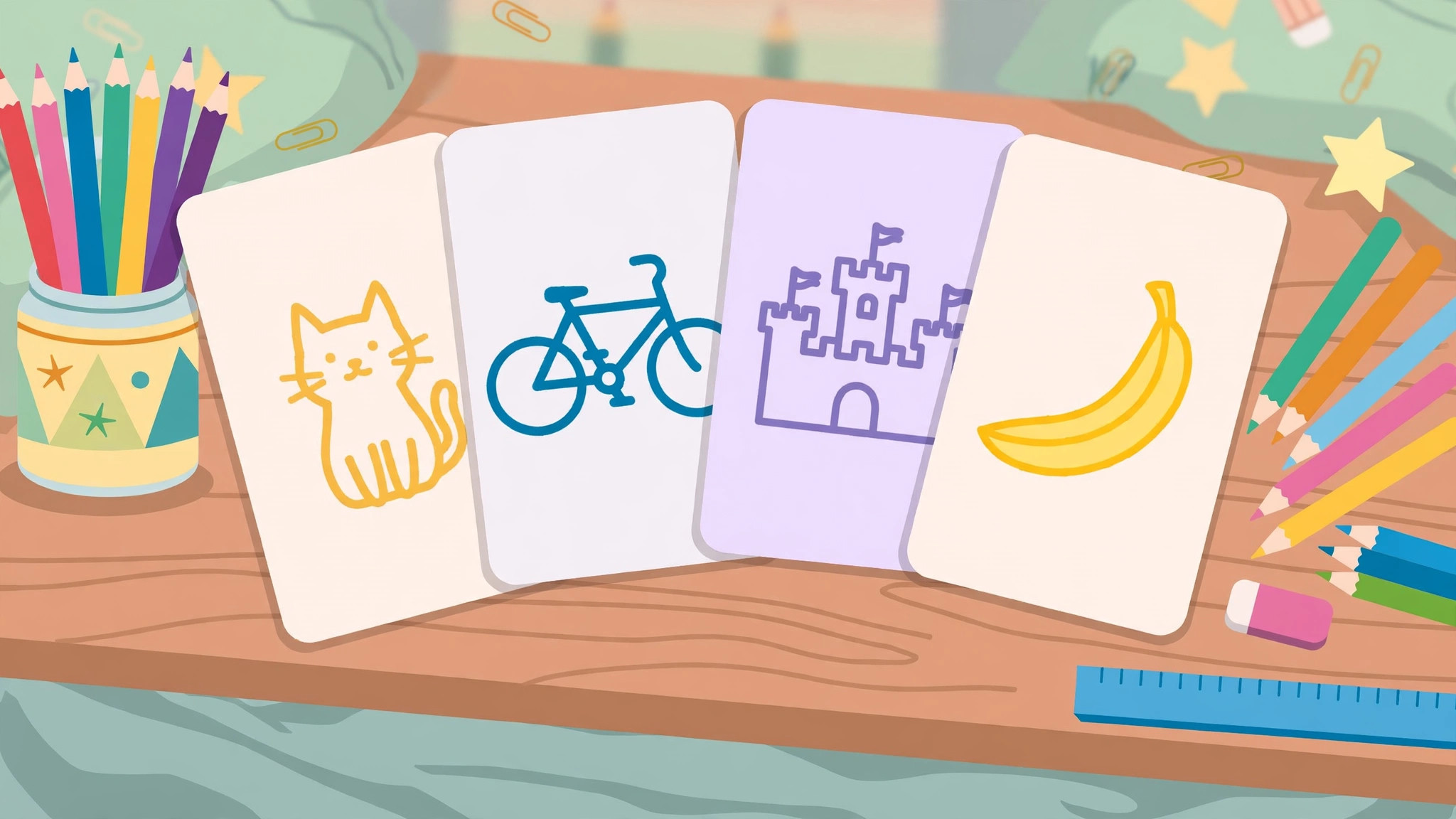
It is also the great equalizer for classes where the same three students win every quiz-based mode. Drawing flattens the hierarchy: handwriting-speed, visual thinking, and sheer guess-confidence shuffle a deck that trivia had stacked. Students who never see their names near the top of a Gimkit leaderboard get a real, unironic shot in this mode, and a teacher who schedules it occasionally buys engagement from exactly the students the quiz modes keep shelving.
One framing tip before the first game: announce that bad drawings are the game, not a failure at it. Classes laugh with artists when the teacher sets that tone, and laugh at them when nobody does. The difference between those two rooms is about ten seconds of introduction.
For its trivia-reversed cousin, where players are handed answers and must guess the question, see Gimkit ‘What Is…’ Mode. Availability follows the usual pattern: modes rotate in the featured list on the free plan and Gimkit Pro unlocks all modes, so check the picker before the lesson and consult the official Gimkit Help Center for the platform’s documentation.
Frequently asked questions
Do you need to be good at drawing to win Draw That?
No. You need to be good at choosing clear, simple representations. The winning drawings are big, bold, and built from a thing’s most recognizable features. Artistic talent is nearly irrelevant; visual communication is everything.
How do you guess faster in Draw That?
Guess the category the moment you can, then narrow with every line the artist adds. Offer guesses freely: being wrong is cheap, and being slow is what actually loses rounds.
What makes a drawing easy to guess?
A signature feature drawn large, plus a context clue: the plate under the food, the leash on the animal, the sun over the landscape. Context tells guessers which world to search in.
Is Draw That useful for learning, or just a fun break?
Both, genuinely. Teachers who dismiss it as a reward-day toy miss that the guessing side is high-repetition vocabulary retrieval with instant feedback, the single most efficient shape practice can take. Guessing demands precise vocabulary under pressure, and drawing a prompt demands understanding it well enough to translate it. Language teachers in particular get real work out of the mode.
Does Draw That give XP and GimBucks?
Draw That is a party-style mode rather than a 2D mode, so it does not feed the 2D XP-and-GimBucks loop. Its rewards are the rounds themselves: the guesses, the gasps, and the one drawing so baffling that the class votes to frame it, which students will inform you are better anyway.