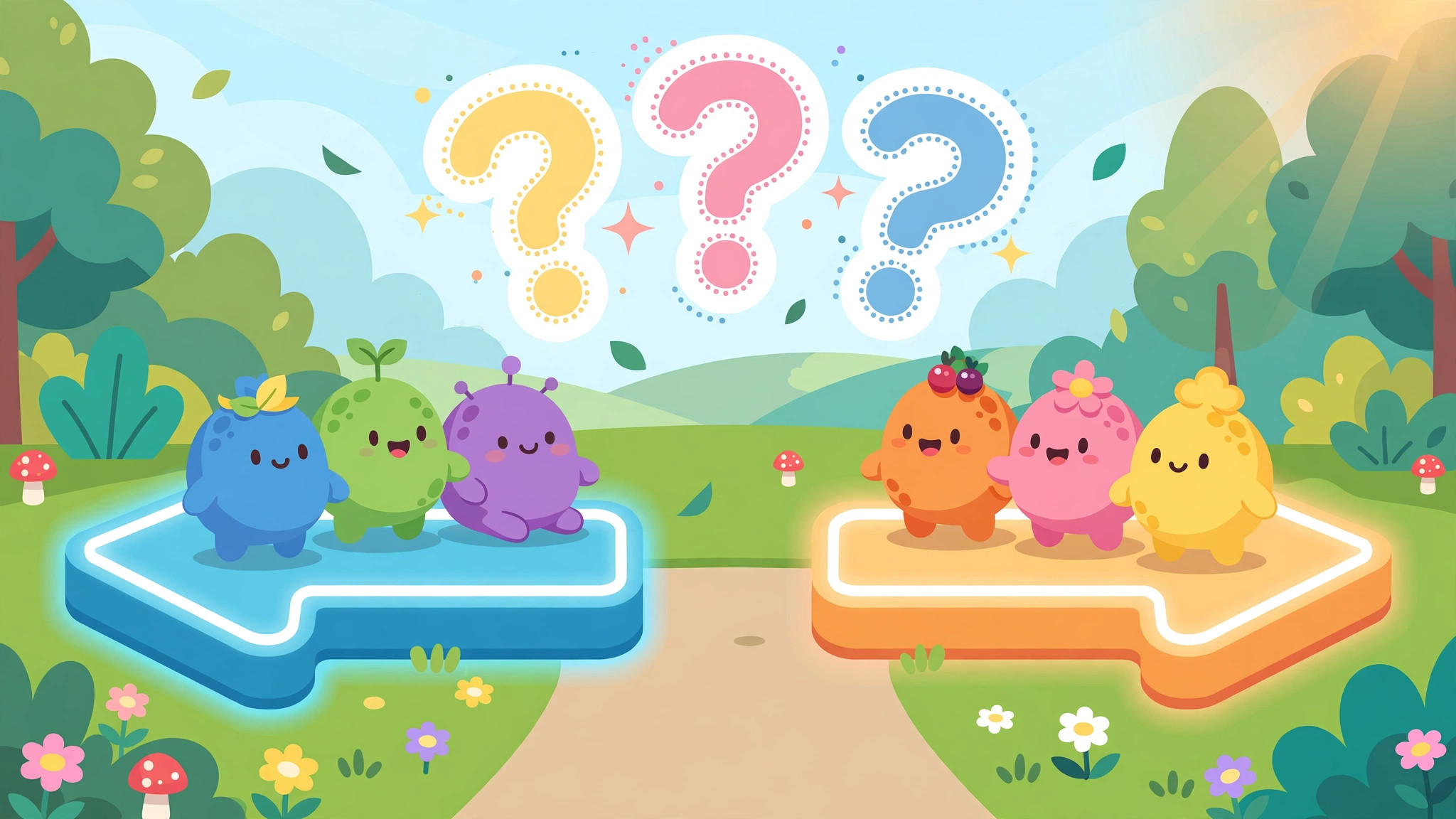
Pizza or tacos? Beach or mountains? Superpower to fly, or superpower to be invisible? Gimkit This or That takes the world’s simplest argument starter and turns it into a full Gimkit game mode, where your class votes with its feet: two options appear, everyone scrambles to the side of the arena showing their pick, and the split of the room becomes the game.
It sounds like a party trick, and that is exactly its power. Gimkit This or That wraps real review questions inside a format students would happily play with no educational excuse at all. Between votes, players answer the kit’s questions to earn energy and move around the 2D space; when a new choice drops, the whole class erupts. This guide explains how the mode works round by round, why it is such a reliable icebreaker, and how teachers can use the choices themselves as teaching material.
how to play this or that gimkit
This or That is a 2D mode, so everyone plays as a Gim in a shared space, moving with WASD or the arrow keys (or the joystick on touch screens). As in every 2D mode, answering questions correctly earns energy, and energy powers movement, so the academic work never actually stops; it just shares the stage with the voting.
A round plays out like this:
- A choice appears. Two options are presented to the whole class: this or that. The prompts are quick, visual preference questions designed to split opinions.
- Players vote with their Gims. You move your character to the side of the space representing your pick. Your body is your ballot.
- The room’s split is revealed. Once voting closes, everyone sees exactly how the class divided. The groans, cheers, and disbelief are the point.
- Questions fill the space between votes. Between choices, players answer the kit’s questions to build energy and reposition, so the review content keeps flowing while the next vote brews.
- New choices keep coming. Round after round, the class keeps picking sides, arguing happily, and answering questions in between.
The genius of the design is that the “game” part requires no skill barrier at all. There is no aim to master, no map to memorize, and no way to be bad at having an opinion. A shy student who would never raise a hand will sprint their Gim across the arena to defend the honor of waffles over pancakes. That is engagement a worksheet cannot buy.
For teachers, the practical flow matters too. Hosting works like other modes: pick a kit, choose This or That in the mode picker, share the code, and start. Our overview of Gimkit 2D modes shows where it sits in the full 2D family, and it frequently tops the fun rankings in our best Gimkit game mode guide precisely because it asks so little of players and gives so much back.

this or that mode gimkit
It is worth pausing on what kind of mode this actually is, because it breaks the usual Gimkit pattern. Most modes are economies or contests: earn cash, knock someone out, reach the top. This or That mode in Gimkit is fundamentally a social mode. The “score” that matters to students is not points; it is the visible opinion of their peers, updating live, choice after choice.
That social core makes the mode unusually useful for things other modes cannot do. It is a genuine icebreaker at the start of a school year, because ten rounds of voting teach a class more about each other than a week of introductions. It is a soft landing for a substitute teacher, because the format runs itself and behavior problems have very little room to grow inside it. And it is a natural exit ticket: end the day with five minutes of voting and you leave students talking about your class in the hallway, which every teacher knows is where tomorrow’s attention is won or lost.
The questions woven between votes deserve attention too. Because students are emotionally warmed up by the voting, they answer the review questions in a completely different mood than they would in a drill. Teachers report using This or That precisely for the review sets students resist most: the questions ride in on the fun rather than fighting it.
One more design detail students love: the splits are rarely 50/50, and the minority side becomes a badge of honor. Being one of four students on the “correct” side of a ridiculous question is the kind of tiny social drama that classes remember for weeks. Gimkit This or That manufactures those moments on an assembly line.
Using the choices as teaching material
Here is the move that separates a fun Friday from a genuinely good lesson: treat the votes as data. Every split is a ready-made discussion prompt, and the best teachers harvest them.
Start with the obvious: after a lopsided vote, ask why. “Eighty percent of you picked the beach. Defend it.” Thirty seconds of that is a speaking-and-listening exercise hiding inside a game. After a close vote, ask the minority to persuade: “Four people picked winter over summer. Change our minds.” That is argumentative writing, out loud, with an audience that cares.
The votes also make natural bridges into real content. A choice between two historical figures becomes a debate warm-up. A choice between two answers to a math estimation problem becomes a lesson in reasonableness (and the split tells you instantly who is guessing). A choice between two vocabulary words becomes a connotation discussion. Teachers who plan their kit questions and their voting prompts as one lesson get double value from the same class period.
Finally, the mode is a low-stakes way to teach data literacy itself. Percentages, majorities, and sample bias (“our class is not the whole school, is it?”) are all sitting right there on the results screen. Younger classes can simply count and compare; older classes can argue about whether the vote would hold school-wide. Few review games hand you a statistics discussion for free.
For elementary classes especially, the gentle format shines: our guide to Gimkit for elementary students explains how modes like this fit younger learners. And when you need the platform’s official word on hosting or availability, the Gimkit Help Center is the place to confirm, since featured modes rotate on the free plan while Gimkit Pro unlocks them all.
What makes a great This or That question?
After a few sessions, classes start asking for better questions, and teachers start realizing the prompts themselves are a craft. The questions that produce the loudest rounds share a few traits worth stealing.

They are genuinely balanced. “Ice cream or homework?” produces a boring 28-to-1 split. “Ice cream sundae or warm brownie?” splits a room down the middle and starts real arguments. A great This or That question has two defensible answers; the drama lives in the near-tie.
They are concrete and visual. Students argue hardest about things they can picture: sleeping in a treehouse versus a castle, owning a dragon versus a spaceship. Abstract choices (“freedom or safety?”) belong in older classes’ debates, where they are excellent, but younger students vote with the picture in their head.
They escalate gently. Start with food and animals, move to superpowers and impossible scenarios, and save the class-specific questions (“Ms. R’s quizzes or Mr. T’s quizzes?”) for when the room is warm. The arc matters: early easy votes teach the mechanic, late personal votes make the memories.
They occasionally smuggle in the subject. A history class can vote between two eras; a science class between two animals’ adaptations; a math class between two estimation strategies. Students barely notice the transition from party game to content, which is precisely why it works. The vote is the hook, and the discussion afterward is the lesson.
If you write your own prompts, keep them short enough to read at a glance and kind enough that no student’s honest answer makes them a target. The mode runs on good-natured disagreement, and ten seconds of care in prompt-writing protects that.
Frequently asked questions
How do you vote in This or That?
With your feet. Two options appear, and you move your Gim to the side of the space showing your choice. When voting closes, the whole class sees the split.
Is This or That a competitive mode?
Not in the usual sense. There are no knockouts and no cash race. The fun is social: picking sides, seeing how the class splits, and arguing about it, while review questions keep flowing between votes.
Does This or That still review content?
Yes. Between votes, players answer the questions from the teacher’s kit to earn energy, so the academic material is woven through the whole game.
Does This or That give XP and GimBucks?
Yes. It is a 2D mode, and 2D modes award XP for correct answers and objectives, which converts into GimBucks for Gims, trails, and stickers.
When is the best time to use This or That?
As an icebreaker, a warm-up, an exit ticket, or a reward review. It asks nothing of students except an opinion, which makes it ideal for low-energy days and new classes.