

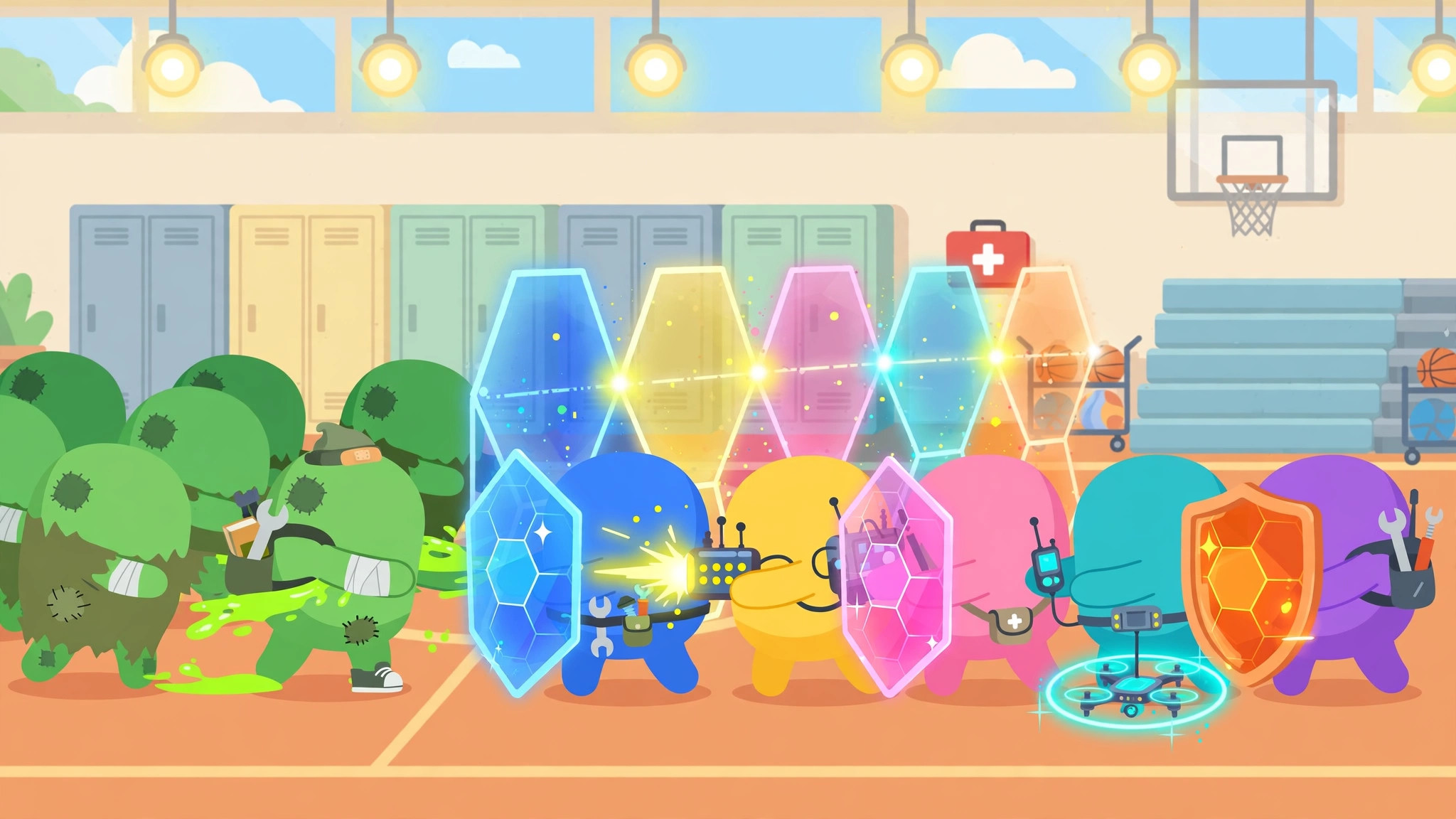
The zombies are coming in waves, the waves are getting bigger, and the only thing standing between your class and a full apocalypse is how fast everyone can answer review questions. Gimkit Apocalypse is Gimkit’s wave-survival 2D mode: a whole team of players holds ground together against escalating hordes of zombies, fighting them off with gadgets while correct answers keep everyone’s energy and defenses alive.
Where most Gimkit modes make students compete, Apocalypse makes them depend on each other. A player who stops answering does not just fall behind personally; they leave a gap in the line that the whole team pays for. That shared pressure, plus the natural drama of “one more wave,” makes it one of the most replayable modes in the library. This guide explains how a run works, how the waves escalate, the roles that good teams fall into, and the survival habits that carry classes into the late game.
how to play apocalypse gimkit
Apocalypse is a 2D mode, so you play as a Gim in a side-view world, moving with WASD or the arrow keys (or the joystick on touch devices). Answering questions correctly earns energy, and energy powers your movement and your ability to fight. Your opponents are not other students; they are waves of zombies that advance on your team’s position.
A run unfolds like this:
- The team takes its ground. When the game starts, players gather in the play area and get oriented. The calm at the start is brief, so use it to spread out sensibly rather than clumping in one corner.
- The first wave arrives. Zombies begin advancing. Players use their gadgets to knock them back and knock them out before they reach the team.
- Answer to stay dangerous. Every gadget blast and every reposition depends on energy, and energy depends on answering. The team’s firepower is literally its question speed.
- Survive, then breathe. Clearing a wave earns a short lull. Use it to regroup, rebuild energy, and reset positions before the next wave lands.
- Waves escalate. Each new wave is a sterner test than the last: more pressure, less room for error, and more punishment for a disorganized line.
- The run ends when the team falls. Your result is measured by how far your team got. Then everyone immediately wants to run it back and beat it.
The single most important thing to understand is that this is a team score, not an individual one. A star player cannot carry a silent team, because zombies arrive from the flow of the game, not from one direction, and one star cannot cover the whole line. If your class enjoyed the shared-goal design of Gimkit One Way Out, Apocalypse is its louder, faster cousin; our Gimkit 2D modes guide shows the rest of the family tree.
How the waves escalate
Early waves are a tutorial wearing a costume. They teach the team the rhythm (answer, aim, knock back, regroup) at a pace that forgives mistakes. Almost every class survives the opening comfortably, and that comfort is the trap: teams that spend the easy waves goofing around arrive at the real test with bad habits and worse positions.
The middle waves are where Apocalypse is actually decided. The pressure rises enough that individual heroics stop working: a player who charges forward alone gets swarmed, and a cluster of players standing together can be overrun from one side. This is where spacing, communication, and steady answering start to matter more than aim. Teams usually feel the shift as a single bad wave that breaks their formation, and the lesson (hold the line, cover the flanks) sticks because they learned it by failing.
Late waves are an endurance test. The question is no longer whether your team understands the game; it is whether everyone can keep answering accurately while tired, excited, and shouting. Accuracy matters doubly here, because a string of wrong answers starves exactly the energy the team needs most. The classes that post famous survival runs are rarely the ones with the best aim. They are the ones still answering calmly at the point where other classes have dissolved into noise.
gimkit apocalypse survival tips
- Hold a line, not a clump. Spread across the team’s ground so every approach is covered. A clump defends one direction brilliantly and every other direction not at all.
- Answer before you need the energy. Bank energy during the lulls between waves. Starting a wave on a full tank is the simplest survival advantage in the mode.
- Protect the flanks. Zombies that get around the side of a formation cause the collapses that end runs. Assign your most reliable players to the edges.
- Call targets out loud. “Left side, three coming” is genuinely useful information. Quiet teams get surprised; loud teams get warned.
- Do not chase kills. Knocking out one more zombie at the cost of your position trades a point of pride for a hole in the line. Let zombies come to the team’s ground.
- Slow down to speed up. Rushed answering creates errors, and errors starve energy. A slightly slower, accurate rhythm outlasts frantic guessing every single wave.
- Reset after every wave. The lull is part of the game. Rebuild energy, re-form the line, and agree on anything that went wrong before the next wave arrives.
Roles on a strong team
Nobody assigns these roles officially, but every good Apocalypse team grows them within a run or two. Recognizing them helps teachers coach a struggling class without a lecture.
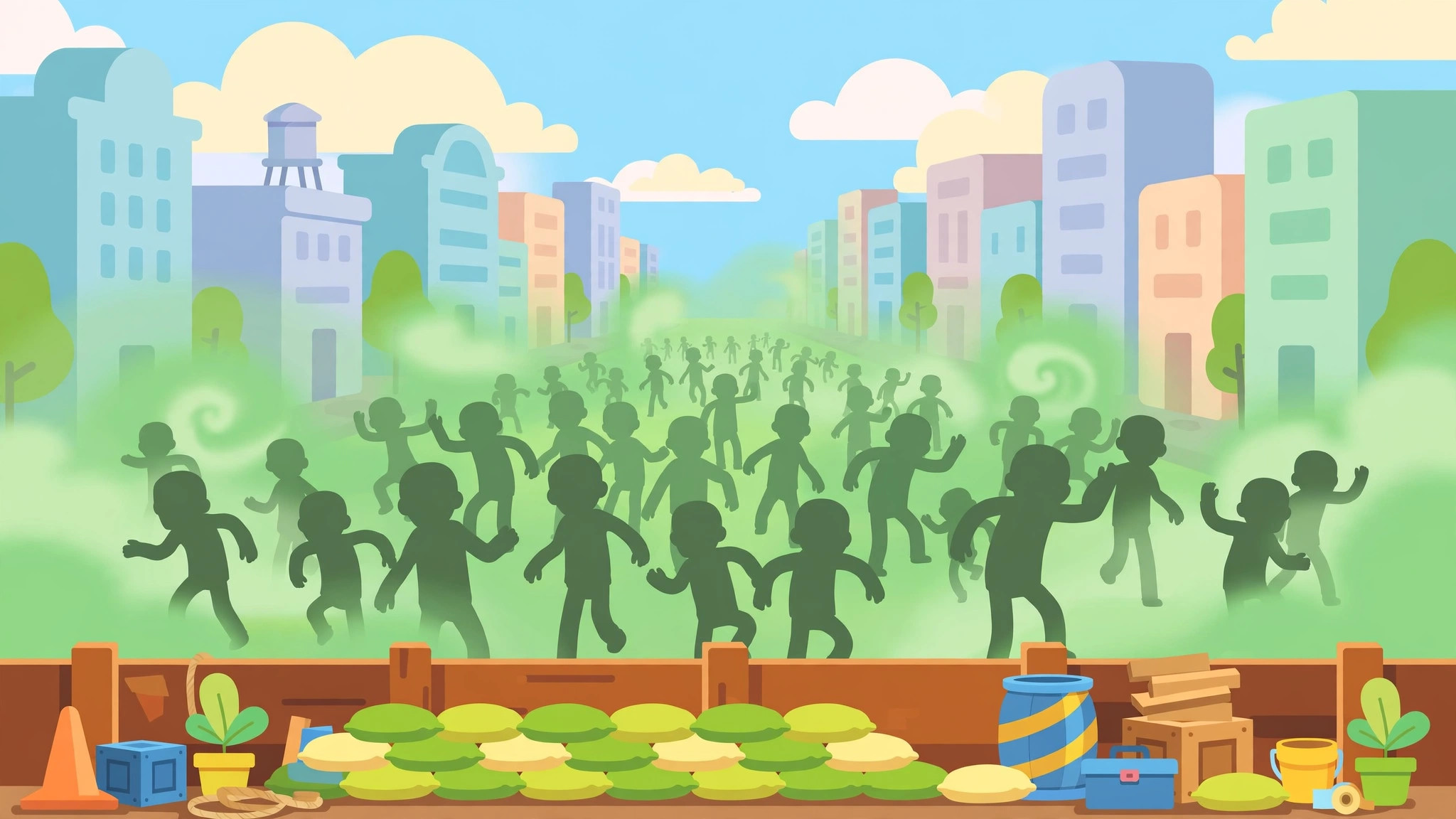
Anchors are the steady players who hold the center of the line, answer consistently, and rarely make mistakes. They are not flashy, and the team collapses without them. Flankers are quicker, more confident players who take the edges, where pressure arrives unevenly and improvisation matters. Floaters watch the whole field and plug gaps, reinforcing whichever side is about to break. And callers are the loud ones, in the best way: they announce incoming pressure and keep the team’s attention pointed at the real threat.
The nice thing for a teacher is that these roles reward different strengths. The careful student anchors, the bold student flanks, the observant student calls. A class that cannot find a role for everyone in a PvP mode usually can in Apocalypse, and the zombie theme does the motivational work that a worksheet never could. If your group prefers its zombie action competitive, Gimkit Humans vs Zombies splits the class into two sides instead.
When a run starts to collapse
Every Apocalypse run has a moment where it nearly ends before it actually does: a flank breaks, two players are suddenly overwhelmed, and the line starts folding like a tent. What separates teams that recover from teams that wipe is what happens in the next ten seconds.
The recovering teams do three things. First, they contract. Instead of trying to restore the whole line at once, they pull back to a tighter formation around their anchors, giving up ground deliberately to save the team. Ground can be retaken; eliminated momentum cannot. Second, they pour everything into answering for a few seconds, even if it means letting zombies advance, because energy is the only resource that buys a comeback. Third, someone calls the reset out loud. It sounds trivial, but a single voice saying “pull in, rebuild, hold” stops the panic spiral that actually kills most runs.
The wiping teams do the opposite: everyone sprints in a different direction, answers frantically and wrongly, and tries to be the individual hero. Apocalypse is designed so that heroics fail. The zombies do not care about your highlight play; they care about the gap you left.
Teachers can freeze this into a teaching moment after a run: ask the class where the collapse started and what the team did next. Classes that can name their collapse tend to fix it in the rematch, and watching a team consciously recover from a broken flank is the most satisfying moment the mode offers.
Apocalypse in the classroom
Choose Apocalypse when the goal is shared effort: the day before a break, a tough review after a hard unit, or any time a class needs to feel like a team rather than a leaderboard. It rehearses exactly the behaviors teachers say they want (communication, composure, helping under pressure) inside a theme students would choose for themselves.
Hosting-wise, plan a full slot, because the second run is always the serious one and students will lobby for it. Set the noise expectation early: this mode generates cheering by design. Like other 2D modes it awards XP for correct answers and objectives, feeding GimBucks and cosmetics. Featured modes rotate on the free plan while Pro unlocks all modes, so confirm availability in your mode picker, and check the official Gimkit Help Center if you need the platform’s current documentation.
Frequently asked questions
Is Apocalypse played against other students?
No. Your opponents are waves of zombies controlled by the game. The whole class plays on the same team, trying to survive as many waves as possible.
How does a run of Apocalypse end?
When the zombies overwhelm the team. Your result is how far your team got, measured in waves survived, and the natural next step is always a rematch.
What is the most important skill in Apocalypse?
Steady, accurate answering. Energy powers everything, and teams fall when their answering collapses under pressure, not when their aim does.
Does Apocalypse give XP and GimBucks?
Yes. It is a 2D mode, and 2D modes award XP for correct answers and objectives, which converts into GimBucks for Gims, trails, and stickers.
How is Apocalypse different from Humans vs Zombies?
Apocalypse is cooperative: everyone fights the game’s zombies together. Humans vs Zombies is competitive, splitting players into a human team and a zombie team that tries to convert every human before time runs out.
